
Manual Transmission Components: A Comprehensive Overview
Manual transmissions feature key parts like the clutch‚ gears‚ shafts‚ and gearbox housing‚ enabling drivers to control gear selection and vehicle speed effectively.
Manual transmissions represent a foundational technology in automotive engineering‚ directly connecting the engine’s power to the wheels via a driver-controlled system. Unlike automatic systems‚ they require the operator to select gears manually using a clutch and shift mechanism. Core components include the input shaft‚ output shaft‚ and intricate gear sets housed within the gearbox.

Understanding these systems involves recognizing the roles of synchronizers‚ shift forks‚ and the crucial clutch – all working in harmony to deliver controlled power transfer. These transmissions offer a direct driving experience‚ prioritizing driver engagement and mechanical efficiency.
Historical Context of Manual Transmissions
Manual transmissions predate automatic systems‚ emerging alongside the earliest automobiles. Initially‚ they were simple‚ direct-drive systems‚ evolving with the addition of multiple gear sets for increased versatility. Early clutch designs were rudimentary‚ requiring significant driver effort. Over time‚ advancements in metallurgy and engineering led to more robust shafts‚ refined synchronizers‚ and smoother shift mechanisms.
The development of the gearbox housing also progressed‚ improving durability and reducing noise. These early systems laid the groundwork for the sophisticated manual transmissions we know today‚ influencing automotive design for decades.

Core Components of a Manual Transmission
Core components include the clutch system‚ gearbox assembly‚ and synchronization system‚ working in harmony with the shift mechanism to transfer engine power.
The Clutch System
The clutch system is a vital link between the engine and the manual transmission. It temporarily disconnects the engine’s power‚ allowing for smooth gear changes. Key elements include the clutch disc‚ responsible for engaging and disengaging power‚ and the pressure plate‚ which clamps the disc against the flywheel.
The throw-out bearing facilitates this disengagement process. Proper clutch function relies on these components working seamlessly. A failing clutch manifests as slippage or difficulty shifting‚ impacting vehicle performance and requiring prompt attention for continued reliable operation.
Clutch Disc Functionality
The clutch disc‚ a friction material sandwiched between the flywheel and pressure plate‚ is central to power transfer. Its primary function is to engage and disengage the engine’s rotational force to the transmission. Constructed with friction linings‚ it grips the flywheel when engaged‚ transmitting power.

When the clutch pedal is pressed‚ the disc separates‚ interrupting this connection. Wear and tear on the friction material reduce its effectiveness‚ leading to slippage. Maintaining a functional clutch disc ensures smooth gear changes and optimal vehicle performance‚ preventing damage to other components.
Pressure Plate Mechanics
The pressure plate exerts constant clamping force onto the clutch disc against the flywheel‚ facilitating power transmission. It comprises a diaphragm spring‚ release fingers‚ and a cover assembly. When the clutch pedal isn’t pressed‚ the spring maintains pressure.
Upon pedal depression‚ the release fingers disengage this force‚ allowing the clutch disc to separate. Proper function relies on consistent spring pressure and smooth release action. Wear or damage to the diaphragm spring or release fingers compromises clamping force‚ leading to clutch slippage and requiring replacement for optimal performance.
Throw-Out Bearing Role
The throw-out bearing‚ also known as a release bearing‚ disengages the clutch by applying force to the pressure plate’s release fingers when the clutch pedal is depressed. It’s crucial for smooth gear changes‚ preventing constant friction during gear selection.
This bearing doesn’t rotate when the clutch is engaged‚ only during clutch operation. Constant use and heat can cause wear‚ leading to noise or difficulty disengaging the clutch. Regular inspection and replacement are vital to avoid transmission damage and ensure reliable clutch functionality.
Gearbox Assembly
The gearbox assembly is the heart of a manual transmission‚ housing the gear sets responsible for altering the vehicle’s speed and torque. It contains the main shaft (input and output) and the countershaft‚ also known as the lay shaft‚ working in concert to transfer power.
Different gear ratios provide varying levels of mechanical advantage. The gearbox’s robust construction ensures durability‚ while precise machining guarantees smooth and efficient power delivery. Proper lubrication and maintenance are essential for optimal performance and longevity of this critical component.
Gear Sets and Ratios
Gear sets within the gearbox are meticulously designed to provide a range of gear ratios‚ influencing both speed and torque output. Lower gears offer increased torque for acceleration and climbing‚ while higher gears prioritize fuel efficiency at cruising speeds.
The specific ratios are determined by the number of teeth on each gear‚ impacting the rotational speed of the output shaft. Careful selection of gear ratios is crucial for optimizing vehicle performance based on intended use‚ ensuring a balance between power and efficiency.
Main Shaft (Input & Output)
The main shaft is a critical component‚ comprising both the input shaft and the output shaft. The input shaft receives power directly from the engine’s flywheel via the clutch. It then transmits this rotational force to the gearbox internals.
Conversely‚ the output shaft delivers the modified torque and speed to the driveshaft and ultimately‚ the wheels. These shafts are precision-engineered to withstand significant torsional stress and ensure efficient power transfer throughout the transmission system‚ vital for vehicle operation.
Countershaft/Lay Shaft Details
The countershaft‚ often called the lay shaft‚ plays a pivotal role within the manual transmission. Positioned parallel to the main shaft‚ it receives power from the input shaft and distributes it to the various gear sets. Different sized gears on the countershaft interact with gears on the main shaft‚ establishing different gear ratios.
This arrangement allows for torque and speed adjustments‚ providing the necessary power for varying driving conditions. Its robust construction ensures durability and efficient power transmission‚ contributing to the overall performance of the manual gearbox.
Synchronization System
The synchronization system is crucial for smooth gear changes in a manual transmission. It equalizes the speeds of the gears before engagement‚ preventing grinding and ensuring a seamless shift. This system utilizes synchronizer sleeves and synchronizer cones.
The sleeve moves axially to engage the desired gear‚ while the cone creates friction‚ matching the speeds. Without synchronization‚ shifting would be difficult and damaging to the gearbox. This intricate mechanism is vital for driver comfort and transmission longevity‚ enabling precise gear selection.
Synchronizer Sleeve Operation
The synchronizer sleeve is a key component‚ sliding along the splines of the gear to facilitate engagement. Activated by the shift mechanism‚ it moves towards the target gear‚ contacting the synchronizer cone. This initial contact creates friction‚ gradually matching the speeds of the sleeve and the gear.
Once speeds are synchronized‚ the sleeve fully engages‚ locking the gear to the shaft. Precise movement and proper lubrication are essential for smooth operation. A worn sleeve can cause difficulty shifting or gear noise‚ impacting the overall driving experience.
Synchronizer Cone Function
The synchronizer cone plays a crucial role in achieving smooth gear changes within a manual transmission. Its angled surface interacts with the corresponding cone on the synchronizer sleeve. This interaction generates frictional force‚ effectively equalizing the rotational speeds of the gear and the main shaft before full engagement.
A properly functioning cone ensures a seamless transition between gears‚ preventing grinding noises and minimizing wear. Damage or wear on the cone surface compromises synchronization‚ leading to difficult shifting and potential transmission damage. Maintaining cone integrity is vital.
Shift Mechanism
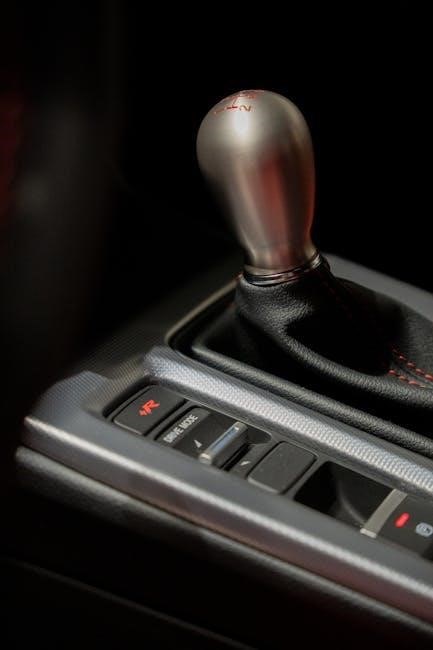
The shift mechanism is the driver’s interface to select desired gears in a manual transmission. It comprises shift forks‚ moved by shift rods and linkages‚ which engage sleeves to select gears. The shift knob‚ connected to a selector rail‚ transmits driver input.
Precise movement is critical; worn components can cause imprecise shifts or difficulty selecting gears. Proper adjustment and lubrication of these parts are essential for smooth operation. A well-maintained shift mechanism ensures reliable gear changes and enhances the driving experience.
Shift Forks and Their Movement
Shift forks are crucial components within the manual transmission’s shift mechanism‚ directly engaging with synchronizer sleeves to select gears. Their movement‚ dictated by shift rods‚ is a precise linear motion. These forks slide along grooves in the shift rail‚ pushing or pulling the synchronizer sleeve to lock the desired gear onto the shaft.
Wear or damage to shift forks can lead to sloppy shifting or difficulty engaging certain gears. Proper lubrication and inspection are vital for maintaining smooth and accurate gear selection.
Shift Rods and Linkages
Shift rods and linkages form the connection between the shift knob and the internal shift forks within the manual transmission. These rods translate the driver’s gear selection into mechanical movement‚ precisely positioning the forks to engage the desired gears. Linkages often employ ball-and-socket joints to accommodate angles and vibrations.
Proper adjustment and lubrication of these components are essential for smooth‚ accurate shifting. Worn or loose linkages can result in imprecise gear engagement and a frustrating driving experience‚ requiring careful inspection and maintenance.
Shift Knob and Selector Rail
The shift knob is the driver’s direct interface for selecting gears‚ connected to the selector rail within the manual transmission. The selector rail receives input from the shift linkage‚ translating it into movement along a patterned gate. This gate guides the rail to engage specific gears.
The selector rail’s precise positioning is crucial for smooth gear changes. Wear or damage to the rail or its guides can cause difficulty selecting gears. A comfortable and ergonomically designed shift knob enhances the driving experience and control.

Supporting Systems & Parts
Transmission housings‚ bearings‚ bushings‚ seals‚ and appropriate transmission fluids are vital for reliable operation and longevity of the system.
Transmission Housing
The transmission housing serves as a protective enclosure for the intricate internal components of the manual gearbox. Typically constructed from durable cast iron or aluminum alloys‚ its robust design safeguards gears‚ shafts‚ and bearings from external contaminants and physical damage.
Effective housing seals and gaskets are crucial for preventing oil leaks‚ maintaining proper lubrication‚ and ensuring optimal performance. These sealing elements are strategically positioned at housing joints and around rotating shafts. Careful attention to housing integrity is paramount‚ as cracks or distortions can compromise alignment and lead to premature wear or catastrophic failure of the transmission.
Housing Material and Construction
Transmission housings are predominantly crafted from either cast iron or aluminum alloys‚ each offering distinct advantages. Cast iron provides exceptional strength and rigidity‚ effectively dampening noise and vibration‚ making it suitable for heavy-duty applications.
Aluminum alloys‚ conversely‚ offer a lighter weight solution‚ contributing to overall vehicle weight reduction and improved fuel efficiency. The construction often involves precision casting processes‚ ensuring dimensional accuracy and structural integrity. Ribbing and reinforcing features are commonly integrated into the design to enhance stiffness and withstand the substantial stresses generated during operation.
Housing Seals and Gaskets
Transmission housings rely heavily on seals and gaskets to prevent lubricant leakage and maintain internal pressure. These components are strategically positioned at mating surfaces‚ such as where the housing joins with the front and rear covers‚ and around the input and output shafts.
Common seal materials include nitrile rubber‚ silicone‚ and Viton‚ selected for their compatibility with transmission fluid and resistance to temperature extremes. Gaskets‚ typically made from paper‚ cork‚ or rubber‚ ensure a tight seal between stationary components. Proper installation and torque specifications are crucial for preventing leaks and ensuring long-term reliability.
Bearings and Bushings
Bearings and bushings are critical for smooth rotational movement within a manual transmission. Various bearing types‚ including ball‚ roller‚ and tapered roller bearings‚ support shafts and reduce friction. These bearings handle radial and axial loads‚ ensuring efficient power transfer.
Bushings‚ typically made of bronze or plastic‚ provide a low-friction surface for components like shift forks and linkage rods. Maintaining bushing integrity is vital‚ as wear can lead to sloppy shifting and noise. Regular inspection and replacement of worn bearings and bushings are essential for optimal transmission performance and longevity.
Types of Bearings Used
Manual transmissions utilize several bearing types to manage diverse loads and rotational forces. Ball bearings excel in high-speed applications with lighter loads‚ commonly found supporting the input and output shafts. Roller bearings‚ including cylindrical and needle types‚ handle heavier radial loads within the gearbox.
Tapered roller bearings are crucial for resisting both radial and axial thrust loads‚ often used on the differential side. Proper lubrication and sealing are vital for all bearing types to prevent premature wear and ensure reliable transmission operation. Selecting the correct bearing for each application is paramount.
Importance of Bushing Integrity
Bushings within a manual transmission are critical for maintaining precise alignment and minimizing vibration between moving parts. These components‚ typically made of bronze or rubber‚ absorb shock and reduce noise during gear engagement and shifting. Worn or damaged bushings lead to excessive play‚ imprecise shifting‚ and increased wear on gears and shafts.
Maintaining bushing integrity is essential for smooth operation and longevity. Regular inspection and replacement of deteriorated bushings prevent costly damage to other transmission components‚ ensuring optimal performance and driver comfort. Ignoring bushing wear compromises the entire system.

Seals and Fluids
Seals and transmission fluids are vital for a manual transmission’s health. Seals prevent lubricant leakage‚ maintaining proper internal pressure and protecting gears from contamination. Various seal types exist‚ each designed for specific locations and pressures within the transmission housing.
Correct transmission oil specification is crucial; using the wrong fluid can cause damage. The fluid lubricates gears‚ synchronizers‚ and bearings‚ reducing friction and dissipating heat. Regular fluid changes and leak prevention are essential for reliable operation and extending the transmission’s lifespan.

Transmission Oil Specifications
Transmission oil specifications are critical for optimal manual transmission performance. Manufacturers dictate specific viscosity grades and performance standards – often GL-4 or GL-5 – ensuring proper lubrication and component protection. Using incorrect oil can lead to premature wear‚ synchronization issues‚ and even complete failure.
Synthetic oils generally offer superior thermal stability and protection compared to conventional fluids. Checking the vehicle’s owner’s manual for the recommended oil type is paramount. Regular oil changes‚ adhering to the specified intervals‚ maintain fluid cleanliness and effectiveness‚ prolonging transmission life.
Seal Types and Leak Prevention
Manual transmissions utilize various seal types to prevent lubricant leakage and contamination. Common seals include lip seals (rotary and static)‚ O-rings‚ and gaskets‚ strategically positioned around shafts‚ housings‚ and covers. Regular inspection for signs of wear‚ cracking‚ or deterioration is crucial for leak prevention.
Proper installation‚ using the correct sealant and torque specifications‚ is essential during reassembly. Addressing leaks promptly prevents fluid loss‚ potential damage to internal components‚ and costly repairs. Maintaining a clean sealing surface before installation also contributes to a reliable seal.

Advanced Components & Considerations
Advanced systems‚ like differentials and transfer cases‚ enhance manual transmissions‚ offering improved traction and functionality for diverse driving conditions and vehicle types.
Differential Integration
Differentials are crucial components integrated with manual transmissions‚ managing power distribution to the wheels. Open differentials allow varying wheel speeds during turns‚ while limited-slip differentials enhance traction by restricting speed differences. This prevents wheel spin and maximizes grip‚ particularly beneficial in challenging terrains or performance driving. The differential’s role is to transmit engine torque to the wheels‚ allowing them to rotate at different speeds while still providing power. Proper differential function is vital for smooth cornering and optimal vehicle control‚ ensuring efficient power delivery and enhanced stability.
Open vs. Limited-Slip Differentials
Open differentials‚ the standard type‚ permit independent wheel speeds‚ ideal for normal driving but prone to power loss when one wheel loses traction. Conversely‚ limited-slip differentials (LSDs) mitigate this by transferring torque to the wheel with more grip. LSDs employ various mechanisms – clutches‚ gears‚ or viscous couplings – to restrict excessive speed disparity. This enhances traction on slippery surfaces or during aggressive maneuvers. While open differentials prioritize efficiency‚ LSDs prioritize performance and control‚ offering superior stability and responsiveness in demanding conditions‚ making them popular in performance vehicles.
Transfer Case (4WD/AWD)
The transfer case is a crucial component in four-wheel drive (4WD) and all-wheel drive (AWD) systems‚ situated after the manual transmission. Its primary function is to split torque between the front and rear axles‚ providing enhanced traction on challenging terrains. In 4WD‚ the driver typically selects engagement‚ locking both axles for equal power distribution. AWD systems often utilize a viscous coupling or electronic control to automatically vary torque split. This ensures optimal grip and stability‚ adapting to changing road conditions‚ enhancing vehicle performance and safety;
Functionality in Four-Wheel Drive Systems
In four-wheel drive systems‚ the transfer case receives power from the manual transmission and distributes it to both the front and rear driveshafts. Typically‚ a driver-selectable mechanism engages 4WD‚ often with options for 2-High‚ 4-High‚ and 4-Low ranges. 4-Low provides a lower gear ratio for increased torque‚ ideal for steep inclines or off-road obstacles. The transfer case ensures both axles rotate at the same speed when engaged‚ maximizing traction. Proper functionality relies on a robust chain or gear system within the case‚ delivering consistent power distribution.
Troubleshooting Common Issues
Syncro mesh problems often manifest as difficulty shifting into gear‚ accompanied by grinding noises. This usually indicates worn synchronizer rings or cones‚ requiring transmission disassembly and replacement. Clutch slippage‚ characterized by engine revving without proportional speed increase‚ points to a worn clutch disc or issues with the pressure plate. Diagnosing involves checking clutch cable adjustment or hydraulic system integrity. Ignoring these issues can lead to further damage‚ necessitating complete clutch assembly replacement and potentially transmission overhaul.
Syncro Mesh Problems
Syncro mesh issues typically present as challenging gear engagement‚ often with noticeable grinding sounds during shifts. Worn synchronizer rings or damaged synchronizer cones are frequent culprits‚ hindering smooth gear changes. These components ensure matching speeds before full engagement. A failing synchronizer can cause “double clutching” as a temporary workaround. Diagnosis requires transmission disassembly for inspection. Repair involves replacing worn synchronizers‚ potentially alongside related components like shift forks‚ to restore proper gear selection and eliminate irritating noises.
Clutch Slippage Diagnosis
Clutch slippage manifests as engine RPMs increasing without a corresponding rise in vehicle speed‚ particularly during acceleration. Initial checks involve verifying proper clutch cable adjustment or hydraulic system functionality. A glazed or contaminated clutch disc‚ alongside a weakened pressure plate‚ are common causes. Inspection requires transmission removal. Look for signs of wear‚ heat discoloration‚ or oil contamination on the disc. Replacement of the entire clutch assembly – disc‚ pressure plate‚ and throw-out bearing – is generally recommended for a reliable repair.
Modern Manual Transmission Technologies
Double-Clutch Transmissions (DCTs) represent a significant advancement‚ offering faster‚ smoother shifts through automated clutch operation and dual gear selection. These systems enhance performance and fuel efficiency. Simultaneously‚ ongoing evolution in gear materials focuses on increasing strength and reducing weight. Manufacturers are exploring advanced alloys and surface treatments to withstand higher torque loads and improve durability. These innovations aim to maintain the engaging driving experience of a manual while addressing limitations in shift speed and efficiency‚ pushing the boundaries of transmission technology.
Double-Clutch Transmissions (DCTs)
DCTs utilize two separate clutches for odd and even gears‚ pre-selecting the next gear for incredibly rapid shifts. This eliminates torque interruption during gear changes‚ resulting in a smoother and faster driving experience. Unlike traditional manuals‚ DCTs automate the clutch and shifting process‚ offering convenience without sacrificing performance. They represent a bridge between manual and automatic transmissions‚ providing both driver engagement and efficiency. Modern DCTs often feature paddle shifters for manual control‚ enhancing the sporty feel.
Evolution of Gear Materials
Initially‚ manual transmission gears were crafted from cast iron‚ offering durability but lacking in strength-to-weight ratio. Over time‚ advancements led to the adoption of alloy steels‚ enhancing gear strength and reducing weight. Modern manual transmissions increasingly employ high-strength alloy steels and specialized heat treatments for improved durability and efficiency. Furthermore‚ surface hardening techniques like carburizing and nitriding extend gear life. Research continues into lighter‚ stronger materials like advanced composites‚ aiming to further optimize performance and fuel economy in future transmission designs.